Lua scripting#
Material and frictional parameters used in Tandem simulation are written in Lua script. Here are the key parameters and their descriptions:
Name |
Format |
Description |
Unit |
Default |
|---|---|---|---|---|
boundary |
Functional (space, time) |
Boundary displacement condition governing Dirichlet boundary |
m |
|
a |
Functional (space) |
Rate-and-state direct effect parameter, a |
||
b |
Constant |
Rate-and-state evolution effect parameter, b |
||
L |
Functional (space) |
Critical distance or state evolution distance (D_RS) |
m |
|
V0 |
Constant |
Reference slip rate |
m/s |
|
f0 |
Constant |
Reference friction coefficient |
||
Vinit |
Functional (space) |
Initial slip rate |
m/s |
|
Sinit |
Functional (space) |
Initial slip |
m |
|
mu |
Functional (space) |
Shear modulus |
GPa |
1.0 |
lam |
Functional (space) |
Lamé parameter lambda |
GPa |
1.0 |
eta |
Functional (space) |
Half the shear-wave impedance for radius damping |
MPa s/m |
|
sn_pre |
Functional (space) |
Initial normal stress; Positive in compression |
MPa |
0.0 |
tau_pre |
Functional (space) |
Initial shear traction |
MPa |
|
delta_sn |
Functional (space, time) |
(Optional) Time-dependent change in normal stress |
MPa |
0.0 |
delta_tau |
Functional (space, time) |
(Optional) Time-dependent change in shear traction |
MPa |
0.0 |
source |
Functional (space, time) |
(Optional) Defines an additional source term \(s\) to the state evolution equation \(\psi_{,t} = G(V,\psi) + s(x,t)\) |
||
fault_solution |
Functional (space, time) |
(Optional) Defines slip and state variable. Useful for analytic solutions or manufactured solutions. |
For more descriptions about units and scaling, please check out the Equation scaling section.
Commented lua script:#
local Tutorial = {}
Tutorial.__index = Tutorial

-- constant parameters
Tutorial.b = 0.010       -- Rate-and-state evolution effect parameter, b
Tutorial.V0 = 1.0e-6     -- Reference slip rate [m/s]
Tutorial.f0 = 0.6        -- Reference friction coefficient

-- internal parameters
Tutorial.rho = 2.670     -- Density [g/cm3]
Tutorial.cs = 3.464      -- Shear velocity [km/s]
Tutorial.nu = 0.25       -- Poisson ratio

function Tutorial.new(params)
    -- You can define parameters that you may want to change for each scenario
    local self = setmetatable({}, Tutorial)
    self.dip = params.dip
    self.Vp = params.Vp
    return self
end

function Tutorial:boundary(x, y, t)
    -- Boundary condition governing Dirichlet boundary in the mesh
    local Vh = self.Vp * t / 2.0
    if x < 0 then
        Vh = -Vh
    end
    return Vh, 0.0
end

function Tutorial:mu(x, y)
    -- Shear modulus [GPa]
    return self.cs^2 * self.rho
end

function Tutorial:lam(x, y)
    -- Lame parameter lambda [GPa]
    return 2 * self.nu * self:mu(x,y) / (1 - 2 * self.nu)
end

function Tutorial:eta(x, y)
    -- Half the shear-wave impedance for radiation damping [MPa s/m]
    return self.cs * self.rho / 2.0
end

function Tutorial:L(x, y)
    -- Critical distance or state evolution distance (D_RS) [m]
    return 0.008
end

function Tutorial:Sinit(x, y)
    -- Initial slip [m]
    return 0.0
end

function Tutorial:Vinit(x, y)
    -- Initial slip rate [m/s]
    return self.Vp * math.cos(self.dip * math.pi / 180.0)
end

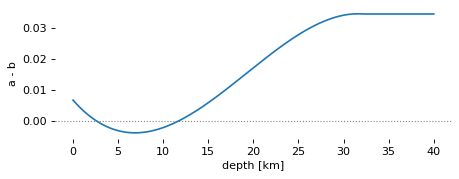
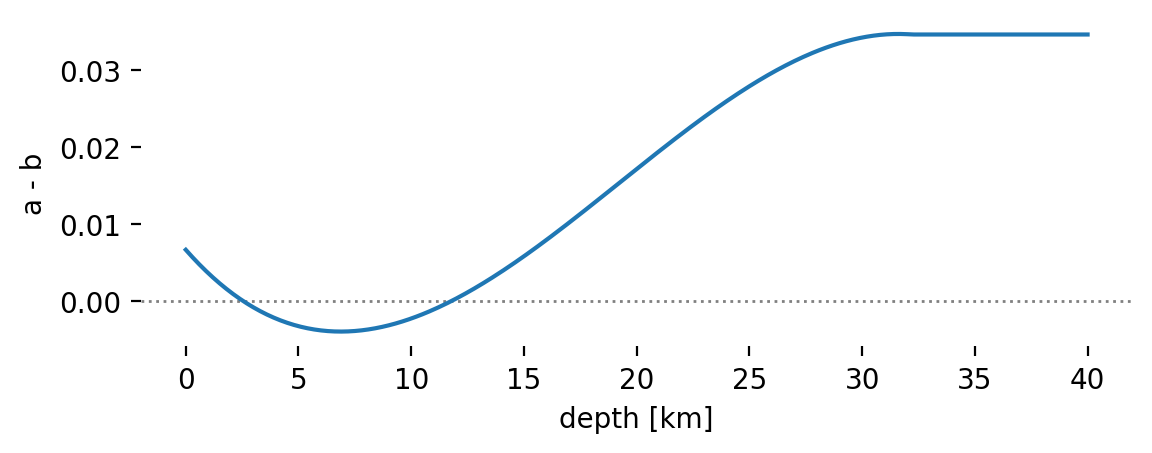
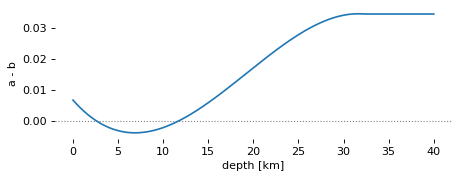
function Tutorial:a(x, y)
    -- Rate-and-state direct effect parameter, a
    local d = math.min(math.abs(y), 32.2)
    return self.b + -5.1115922342571294e-6*d^3 + 0.00029499040079464792*d^2 - 0.003330761720380433*d + 0.0066855943526305008
end

function Tutorial:sn_pre(x, y)
    -- Initial normal stress [MPa]
    return 50.0
end

function Tutorial:tau_pre(x, y)
    -- Initial shear traction [MPa]
    local Vi = self:Vinit(x, y)
    local sn = self:sn_pre(x, y)
    local amax = self:a(0, -40)
    local e = math.exp((self.f0 + self.b * math.log(self.V0 / math.abs(Vi))) / amax)
    return -(sn * amax * math.asinh((Vi / (2.0 * self.V0)) * e) + self:eta(x, y) * Vi)
end

-- Creating various scenarios
normal = Tutorial.new{dip=60, Vp=1e-9}
reverse = Tutorial.new{dip=30, Vp=-1e-9}
(Source code, png, hires.png, pdf)